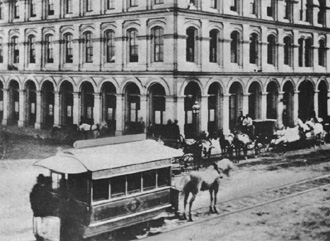
| Street Railways Enable City Growth
As cities throughout the West grew larger, there was an increasing need for public transportation as many people who moved to the cities could not afford their own wagon or carriage. With the development of street railways, people could build homes and live a further distance from the center of town, the railways provided reasonable mobility that enabled workers to reach their jobs and downtown businesses.
Streetcars Pulled by Horses Provide City Mass Transit Roads were typically poor, providing slow bumpy transportation, especially in poor weather. The earliest city street railways consisted of streetcars drawn by horses and sometimes mules. The use of rails had the advantage of less rolling resistance, which greatly improved the comfort and speed of the horse drawn cars, and improved the efficiency of operations. Early street railway operations began in New York City in 1832, on the New York and Harlem Railroad's Fourth Avenue Line, owned John Mason, a wealthy banker. In 1835 the St. Charles Avenue line in New Orleans, Louisiana, followed, beginning as a steam railway line, although it was soon switched to horse and mule pulled streetcars. In San Francisco in 1860 the Pioche Railroad was started by the Market Street Railway Company, which graded Market Street. This road at first was operated by steam dummies, later by horses. Service begins for the Sacramento Pioneers Railroad Company's horse-drawn streetcars on September 18, 1861. In San Jose the First Street Railroad Company began horse drawn streetcar operation in 1872. In Portland, Oregon, horse or mule drawn streetcars also began service in 1872 on the Portland Street Railway Company line on First Avenue from Glisan to Caruthers. In Los Angeles, the Spring and Sixth Street Railway began operating horse drawn streetcars July 1, 1874, created by Robert M. Widney, a real estate promoter. Its route was from the Plaza on Main to Spring to 1st to Fort (Broadway) to 4th to Hill to 6th to Pearl (Figueroa). The single track, narrow gauge railway opened for service with one car. Its barn was at the corner of 6th & Figueroa. Business was good, a second car was soon in service. In November 1874 the line was extended to what is now N. Spring and Alameda, on March 1876 it was extended to East Los Angeles (now Lincoln Heights) via San Fernando St. (N. Spring) and Downey Ave. (N. Broadway) to Gates St. By August 1878 a line was completed via the Plaza, Olvera, Macy, Alameda to San Fernando St.
After selling his interest in the Spring and Sixth Street Railway, Widney opened the East Los Angeles & San Pedro Railway standard gauge line in 1876. The like benefited more from freight business than passenger business. Unfortunately the line ceased to be profitable after the Los Angeles & Independence Railroad extended their service to the Southern Pacific Depot via trackage on Alameda Street. The tracks were removed in early 1880. The Los Angeles & Aliso Avenue Street Passenger Railway began regular service to Boyle Heights in February 1877, benefiting real estate developers and residents in the Boyle Heights area. Hellman, Brodrick and John Wheeler opened the City Railroad of Los Angeles in 1883 from the Southern Pacific depot to a terminus at Washington and Pearl (Figueroa) with two standard gauge horse cars. The City cars made the three mile run in 30 minutes. The company owned five cars and 25 horses allowing them to run a car every 15 minutes.
San Diego's first line began operation on July 3, 1886 when the first San Diego Street Car Company streetcar made its way up Fifth Avenue from the waterfront. These horse pulled streetcars were also popular in many other other growing California cities. The arrival of the Atchison, Topeka and Santa Fe Railway in 1887 sparked a land boom and the need for additional horse car lines on other areas. The Santa Ana, Orange and Tustin Street Railway opened in November 1886. The Anaheim Street Car Company line began service in March 1887. The Orange, Mc Pherson and Modena Street Railway opened in January 1888. It has been estimated that by the late 1880's there were over 500 horse car railway lines running in some 300 cities around the U.S. Over 100,000 animals were used in these operations, operating over 6000 miles of track and carrying 188 million passengers per year. Cable Pulled Street Cars offer Speed, Safety and Cleanliness Improvements In San Francisco and other hilly cities, horses had difficulty pulling the loaded streetcars up the hilly streets. After witnessing an accident where five horses lost their footing, Andrew Hallidie, a successful wire-rope manufacturer, developed a system of pulling streetcars using a cable and pulleys located beneath the street. A large stationary engine pulled the cable throughout the line. Hallidie opened the first successful cable car line was the Clay Street Hill Railroad, September 1, 1873.
Faster and often safer than horse drawn streetcars, "cable car" lines expanded rapidly. By the 1890's, eight companies operated 600 cable cars in San Francisco. They operated on 21 routes for a total of 52 miles. In Los Angeles the first to open was the Second Street Cable Railroad opened a cable line in October 1885 on Second Street from Spring to Texas Street (Belmont Avenue). The line opened with three "dummy" grips and three trailers, each seating about a dozen riders. The primary promoters of the project were officers of the Los Angeles Improvement Co. who reportedly sold almost all of their 1400 available lots within the first year after the line opened. The Temple Street Cable Railway company opened a line along Temple Street between Spring and Belmont on July 14, 1886, with four dummy grip cars and for trailers. The line was opened by real estate promoters. The Temple Street track was extended to Dayton Heights at the city limits in 1888, a transfer point to the Cahuenga Valley Railroad. The line survived until 1898 when it was sold under foreclosure. Henry Huntington acquired the line in 1902, incorporating it into his new Los Angeles Inter-Urban Railway. The Los Angeles Cable Railway incorporated in June 1887, merging the horse powered City-Central and East & West Los Angeles Street Railways. J.F. Crank was president of the new company. Cable car service began in June 1889. Los Angeles Cable Railway became the largest transit venture in the city and operated from Boyle Heights, East Los Angeles out to Westlake Park and Grand Avenue. In late 1889 the company was reorganized as the Pacific Railway Company. In 1890 the company had 45 miles of track, 125 cars, 325 employees and 7 million customers. Its lines radiated to the most established neighborhoods, major parks and railroad depots. Facing high operational costs, competition and declining revenues, the company became insolvent. The company property was sold to the Los Angeles Consolidated Electric in a foreclosure sale in October 1893. In San Diego, the San Diego Cable Railway Company built a 4.7-mile cable car line from Sixth and L downtown to Park and Adams which opened in June 1890. Unfortunately the line wasn't financially successful, the company folded 13 months later. Early Attempts to Introduce Electric Powered Cars Show Some Promise
In Los Angeles, Col. Charles H. Howland was part owner of a tract of land along Pico Street, west of Vermont Street, and in December 1885 obtained a franchise to build a streetcar line which was to be either cable or electric powered. The first electric streetcars in Los Angeles began operating on the Los Angeles Electric Railway Company Pico Street line in January 1887. These cars used a two troller system designed by Leo Daft to get electricity from overhead wires. While the cars were capable of transporting people quickly, technical problems, breakdowns and delayed service were frequent. Following a powerhouse boiler explosion in June 1888, operation resumed with horse cars. Soon after the company declared bankruptcy. In November 1887, the Electric Rapid Transit Company debuted San Diego's first electric streetcar, which also experienced technical problems and breakdowns, and eventually returned to steam dummy operation on the San Diego and Old Town line. The Electric Rapid Transit second line along Fourth Street from G to Fir also shut down weeks at a time for various technical reasons, with horse cars or steam trains filled the gap. Financially unsuccessful, it ended operation in June 1889. Portland’s first electric street railway line, operated by the Willamette Bridge Railway, entered service in November 1889, on the on the Albina Line crossing the Steel Bridge between East Portland and Albina. The cars were a 4-wheel design built by the Pullman Co. of Chicago. Improved Technology Enables Faster, Economical and Frequent Electric Car Service
The newer electric streetcars provided faster, more frequent service in cities throughout the West. Improvements in technology and comfort enhanced travel as the cities grew larger. The San Diego Streetcar Company was purchased by leading San Diego developer and entrepreneur John D. Spreckels in 1892. Along with other lines acquired by Spreckels, it became part of the San Diego Electric Railway Company. The SDERC began electric streetcar service in 1892, using Sprague's electric system. The Los Angeles Railway was formed in 1894, acquiring the lines of the financially troubled Los Angeles Consolidated Electric Railway. The Los Angeles Traction Company, under the leadership of William Hook, started building a competing streetcar system in 1894. By 1899 Hook's green cars were running from their powerhouse and car barn on Georgia Street out West Adams to Arlington, to Boyle Heights via East Fourth, West Eighth past Westlake Park (MacArthur Park) to Hoover, and to Agricultural Park (Exposition Park) via Vermont Ave. Los Angeles area real estate and utility tycoon Henry Huntington, nephew of C.P. Huntington, and his associates gained control of LARY in 1898.
Most city electric streetcar systems used standard gauge track. The Los Angeles Railway used a less common 42 inch narrow gauge track, as had the Los Angeles Consolidated Electric and the Los Angeles Cable Railway. Early California lines often preferred small "California" type cars featuring open and closed sections. As larger cars were built the style continued to be popular. Other city lines preferred completely enclosed cars. In 1910, Henry Huntington sold his interest in the Pacific Electric to the Southern Pacific in return for full ownership of the Los Angeles Railway. The key to separating the lines of the Los Angeles Railway from the Pacific Electric within the city was the track gauge. The Los Angeles Railway owned 172.62 miles of double track, 525 cars, and as of 1912, 27 different routes. During the early 1920's it operated nearly twice as many cars, most running through the core of Los Angeles and serving such nearby neighborhoods as Echo Park, Westlake, Hancock Park, Exposition Park, West Adams, the Crenshaw district, Vernon, Boyle Heights and Lincoln Heights. The LARY carried more than 250 million passengers annually. Streamlined Presidents Conference Committee Cars Introduced
The streamlined cars featured automobile-style controls, fast acceleration and deceleration, better braking and insulated wheels and riggings. The Los Angeles Railway ordered 60 PCC cars and the San Diego Electric Railway ordered 28 PCC cars which began service in 1937. The new cars did little to slow the popularity of the automobile. In 1895 approximately 850 electric car lines were running over 10,000 miles of track throughout the nation. By the late 1920's, more than 1,000 cities and towns had electric streetcar systems operating nearly 63,000 streetcars over about 40,000 miles of track. During World War II, the number of transit passengers peaked at an all-time high of over 23 billion in 1946. Streetcar Lines Replaced by Buses By the late 1930's the LARY was extending service to new areas with busses, not streetcars, and it began to substitute busses for streetcars. The temple Street line was the first line to be converted to bus service. During the 1940's, the Los Angeles Railway system contained over 20 streetcar lines and 1,250 "Yellow Cars." The Los Angeles Railway was sold by Henry Huntington's estate to the National Car Lines in 1944, at which time it was renamed Los Angeles Transit Lines. Gradually many of the streetcar routes were replaced with buses. The last streetcar lines were taken over by a government agency, the Metropolitan Transit Authority (not related to the current agency of that name) in 1958. The agency removed the remaining five streetcar lines in 1963. In San Diego, the San Diego Electric Railway was only operating three railway lines by March 1948. Western Transit Company bought SDERy in July 1948, and changed the name to San Diego Transit. The last rail service in April 1949. After the war, the popularity of suburban living, a growing number of highways, inexpensive fuel prices and good advertising helped make automobile ownership attractive. Cars promised speed, freedom, comfort and convenience, taking people wherever they wanted to travel. Public transportation faced increasing cost, deferred maintenance, declining ridership and declining profits. Perhaps ironically, clogged freeways, crowed streets, rising fuel costs and concerns about air quality have seen a re-birth of electric rail transit in San Diego and Los Angeles, see commuter and city rail transit today.
Interpretation Railroad History Train Technology Railroad Operation Museums & Heritage Railroads Railroads Today
|