
Standard Time essential for Safe and Efficient Train Movement
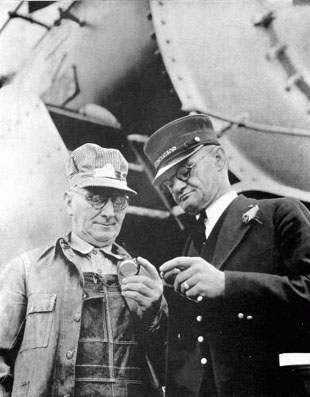 Standard Time is an important factor in railway operations. Safe and efficient movement of trains over single track has been accomplished using timetables, which depends on use of a consistent time and train crews knowing the precise time. In the early years of railroad operation this was not an easy task. During the nineteenth century several major accidents occurred because of differences in time. Safe operation and success of the growing railroads depended on keeping time more consistently and precisely.
During the early years most trains were operated on a single track, with sidings provided at intervals to allow trains going opposite directions or different speeds to pass each other. Railroads operated using a timetable in order to avoid collisions between trains and to move trains efficiently over the railroad lines. A timetable is a published schedule of the movement of trains which lists the trains, locations along the railroad line, and times at which certain events, such as arrivals and departures at a station or siding, are expected to take place.
Using a timetable system, trains can only operate along a section of track in pre-arranged time periods. When trains are moving in opposing directions or at different speeds on a single-track railroad, meets are scheduled, where one train must pull into a siding and wait so the other can pass. In scheduling trains most railroads specified a minimum time interval to allow trains time to pull in and out of sidings and stations.
Solar Time varies with Distance
During the early growth years of the United States and Canada, time of day was a local matter, every community and town world set its official clock, if it had one, or a well-known clock (on a church steeple or in a jeweler's window, for example), according to the local position of the sun. This served adequately until the introduction of the steam engine, the telegraph, and rail travel, which made it possible to travel fast enough over long distances to require almost constant re-setting of timepieces, as a train progressed in its daily run through several towns. When traveling to the east or to the west, local solar time would change by one minute every twelve and 1/2 miles. These differences often let to confusion.
When it is noon in Washington D.C. the local solar time in the following cities is:

Sun time could differ between sides of a large city. In some cities, such as Kansas City, jewelers took their own readings which could vary as much as 20 minutes from another jewelers reading. Kansas City resolved this problem by dropping a large ball from a high mast at the official noon.
Passengers and shippers, as well as railway officers and employees responsible for operation of trains, sale of tickets, and making of schedules, were often confused and bewildered by the multiplicity of time standards throughout the country. Mistakes and errors were frequent and sometimes disastrous.
Time Schedules require Standardized Time
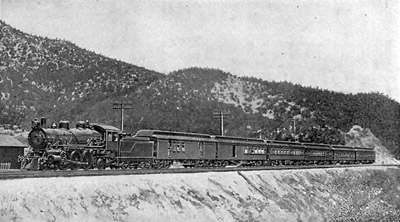 Timetable operation required that all moving trains use a consistent standardized time. Railroad time was first introduced on the Great Western Railway in England in 1840, when a number of different local times were synchronised and a single standard time applied. Railway time was adopted by all of the other railway companies in Great Britain over the following two to three years to using local time for London or "London Time" set at Greenwich by the Royal Observatory, also known as Greenwich Mean Time (GMT).
Each railroad in the United States and Canada began to try to standardize time based on the local time standard adopted by its home city or an important city on its line. In 1943 the Baltimore & Ohio Railroad issued a rule stating "the clock at the Pratt Street depot in Baltimore shall be taken to be the standard time, and all conductors of passenger trains before departing from Baltimore with their trains, are required to have their watches regulated with that clock." Conductors were further instructed to see that all other stations which they pass conform to the standard time," and report any differences to headquarters.1
In July 1853 several rail lines stretching 298 miles from Buffalo to Albany were consolidated as the New York Central Railroad. The New York Central officials adopted a single operating time, the "Standard of Time" given by the "clock in [the] Depot at Albany." Some of the western railroads used Chicago time, others used St. Louis time. The Union Pacific operated on at least six different time standards, based on sun time at Omaha, Jefferson City, St. Joseph, Denver, Laramie and Salt Lake City. When it was noon in Chicago it was 11:50 in St. Louis and 11:27 in Omaha. Where different railroads connected each railroad used its own time standard to govern the arrival and departure of trains.
Use of the telegraph improved the consistence of time at railway stations. William Bond & Son of Boston, started using telegraphed time signals from the Harvard College Observatory in Cambridge to provide authoritative time signals to the Boston area railroads beginning in 1851. A similar service began in New York around the same time.
John C. Adams firm also telegraphed the correct local time to all Chicago & Galena Union Railway Stations starting in 1864 which continued until the Chicago railroads began receiving the time signals directly from the Dearborn Observatory in 1869-1870.
Railroad Standard Time, Time Zones Introduced
A group of railroad superintendents met in St. Louis in 1872 to arrange summer passenger schedules. Desiring a permanent organization they formed the Time-Table Convention which subsequently became the General Time Convention.
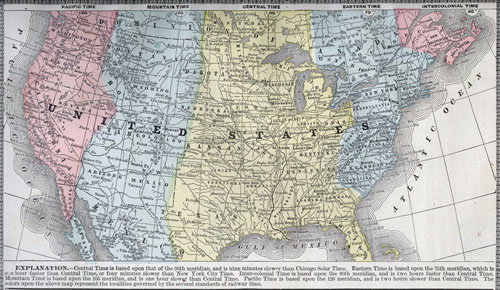 In 1883 the General Time Convention was held in Chicago, at the Grand Pacific hotel. Delegates were asked to develop a better and more uniform time system to govern railroad operations. A Standard Time System, proposed by William F. Allen, established five equal time zones in the U.S. and Canada, each time zone exactly one hour ahead of the zone to its west, allowing the railroads to standardize railroad
schedules. Zones were based upon mean sun-time on meridians west of Greenwich:
In 1883 the General Time Convention was held in Chicago, at the Grand Pacific hotel. Delegates were asked to develop a better and more uniform time system to govern railroad operations. A Standard Time System, proposed by William F. Allen, established five equal time zones in the U.S. and Canada, each time zone exactly one hour ahead of the zone to its west, allowing the railroads to standardize railroad
schedules. Zones were based upon mean sun-time on meridians west of Greenwich:
- Intercolonial - 60th meridian
- Eastern - 75th meridian
- Central - 90th meridian
- Mountain - 105th meridian
- Pacific - 120th meridian

The four meridians in the United States are approximately on the longitudes of Philadelphia, Memphis, Denver, and Fresno.
On October 11, 1883, the new Standard Time System was adopted, superseding some 49 operating times. Allen was Secretary of the General Time Convention and Managing Editor of the Travellers' Official Guide to the Railways.
Nearly all the railroad companies, most cities and influential observatories such as Yale and Harvard supported the plan. The Standard Time System was inaugurated on Sunday, November 18, 1883, newspapers referred to that day as "The Day
of Two Noons." At twelve o'clock noon each railroad station clock was reset as standard-time noon was reached within each time zone. 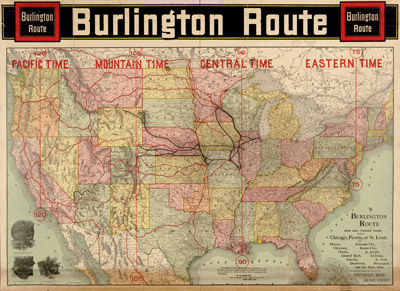 Greenwich Mean Time (GMT)
was transmitted via telegraph, the U.S. Naval Observatory began signaling
the new time standard. Train crews
were instructed as to what change to make in their watches. They were also
instructed to check their watches with the telegraph operator upon arrival
at the next scheduled stop.
Greenwich Mean Time (GMT)
was transmitted via telegraph, the U.S. Naval Observatory began signaling
the new time standard. Train crews
were instructed as to what change to make in their watches. They were also
instructed to check their watches with the telegraph operator upon arrival
at the next scheduled stop.
There was no legislative enactment or ruling, the railroads simply adopted a time zone system encompassing North America, and assumed the public would follow. Most people simply accepted the new time, but a number of cities and counties refused to accept "railroad time" which, after all, had not been made law. Standard time remained a local matter until March 1918, when it was made law as part of the introduction of daylight saving.
During the 1880's the General Time Convention worked to develope a Standard Code of Railroad Operating Rules, an industry code that is still in use. In 1891 the General Time Convention renamed itself the American Railway Association, now the Association of American Railroads.
Operating Trains on Railroad Standard Time
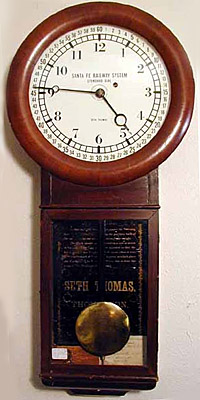 The railroads installed a Standard Clock in major stations. These were high quality pendulum regulators maintained to strict standards. In order to ensure these standard clocks were always correct, a time signal was transmitted by telegraph once every 24 hours, using the resources of the U.S. Naval observatory. The correction signal took the form of a string of dots at one second on, one second off intervals and was transmitted via Morse telegraphy for three minutes prior to the hour (12:00 p.m. EST). This was followed by a 10 second silent period, then a dash at precisely 12:00 p.m. Station agents were thus given a way to spike (correctly set) the clocks at their location.
Ensuring that the railroad workers responsible for the movement of trains knew the accurate time while the train was moving was also critical to safe railroad operation using timetables. Several major accidents pointed out that inaccurate watches created differences in perceived time, leading to accidents, loss of lives and goods. In the early years, reliable watches were expensive and railroad companies differed in their approach to this problem.
The railroad industry was called upon to create standards for watches which all railroads would eventually follow. By 1893 the General Railroad Timepiece Standards Commission presented new guidelines, referred to as the General Railroad Timepiece Standards. Following the adoption of the new Standards, American watch manufactures developed railroad watches to meet the specified railroad standard requirements.
Train dispatchers, conductors, enginemen, brakemen, yardmasters and foremen of yard engines were required to equip themselves with approved railway standard watches. Conductors and enginemen were always to compare their watches before starting on a run or before commencing work each day, other members of the train crew were to compare their watches with the conductor's or engineman's watch at the first opportunity.
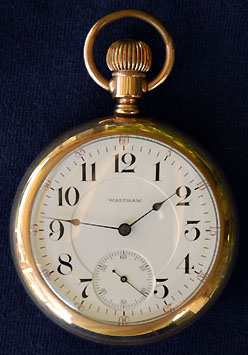 In order to ensure continuing accuracy and facilitate safe railroad operation almost all railroads required periodic watch inspection. Each railroad either established their own specific watch requirements and had its own inspection service, or contracted an inspection service to ensure that all watches in use by specified personnel meet standard requirements. Not all watches manufactured as meeting railroad standards were approved by all railroads. Learn more about the use and standards for railroad watches on North American railroads.
Today the use of radios, automatic block signals, and central computer tracking of trains has lessened the role of the railroad watch on many railroads, yet watch requirements still remain important to safe railroad operation.
For Additional Reading:
Bartky, Ian R. Selling the True Time: Nineteenth century timekeeping in America. Stanford: Stanford University Press, 2000. ISBN 0-8047-3874-2.
Holbrook, Stewart H. The Story of American Railroads. New York, Crown Publishers, 1947. ISBN 1-1221-5378-3.
McCrossen, Alexis. Marking Modern Times: A history of clocks, watches, and other timekeepers in American life. Chicago, University of Chicago Press, 2013. ISBN 978-0-226-01486-9.
1 Bartky, Ian R. Selling the True Time: Nineteenth century timekeeping in America. Stanford: Stanford University Press, 2000. ISBN 0-8047-3874-2.
Railroad Time Railroad Clocks Railroad Watches Approved Watches Watch Use & Care Watch Manufactures
Sharing A Heritage Railroad History Train Technology Railroad Operation Railroad Time Museums & Heritage Railroads Railroads Today
Pacific Time |
|
