

|
Steam Locomotives use pressure to create motion
When inventors proved that a steam engine was capable of moving itself and a string of cars behind it more efficiently than a horse, they gave birth to what future historians will surely look back to as beginning of the transportation age, closely intertwined with the industrial age which it created it, as one of the great ages in the history of mankind. The steam locomotive made it affordable for average people to travel between towns to do business, it made it practical for vendors to sell there crops or wares outside their own town and to purchase food, goods and raw materials from other towns.
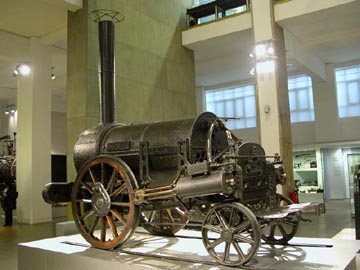
George Stephenson introduced his first steam locomotive, the Blucher, while working at the Killingworth Colliery in 1814. During the years that followed, a slow procession of new inventions began to give shape to this new technology. When the Liverpool and Manchester Railway was approaching completion, the directors of the railway ran a competition to decide whether stationary steam engines and cable or locomotives would be used to pull the trains. The Rainhill Trials were held as an open contest that would let them see all the locomotive candidates in action in October 1829, with the choice to follow. Robert Stephenson entered a more advanced locomotive he called the Rocket, which won the Rainhill Trials and convinced the world that railroads were the wave of the future. Pioneer American Railways first operated steam locomotives in 1829-1830. Horatio Allen successfully ran the first full size locomotive the United States, the Stourbridge Lion, on August 8, along a section of the Delaware and Hudson Canal Company line. The locomotive was English built. The first American built experimental locomotive Tom Thumb was built by Peter Cooper for the Baltimore & Ohio Railroad in August 1830 successfully demonstrating that it could pull 36 passengers at speeds up to 18 miles per hour. Unfortunately Tom Thumb proved too small for regular service.
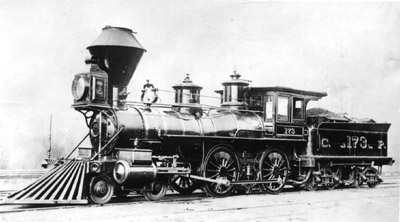
Vertical boilers and other technological improvements led to the operation of steam locomotives on more that 30,000 miles of track are in operation in the United States by 1860, including California. "American" type locomotives with four large driving wheels proved successful for faster passenger service. "Mogul" and "Ten Wheeler" type locomotives with an extra pair of somewhat smaller driving wheels proved most successful for freight service. As locomotive technology improved following the Civil War, the steam locomotives got larger, stronger and faster. On May 10, 1893, New York Central Locomotive No. 999 set a speed record at 112.5 miles per hour, becoming the first train to exceed 100 miles per hour. By the middle of the 1930's a new type of locomotive was beginning to appear on American Railways. This new locomotive used a Diesel generator to create electricity which powered axle-mounted electric motors. Within a decade these new locomotives became more efficient and economical to operate and were replacing steam locomotives, starting with switching assignments in the rail yards in larger cities. On the Southern Pacific, they began being used in main line operation in 1947. The last Southern Pacific steam locomotive was retired in 1957. Read more about diesel electric locomotives.
Steam locomotives produce heat by burning fuel in the firebox located at the bottom of the locomotive, under the boiler. Some steam locomotives were designed to burn wood, some coal, and others fuel oil. The heat produced in the firebox warms the water in the locomotive's boiler. Steam builds up pressure in the boiler above the water level. The steam under pressure is directed into the cylinders, one side of the locomotive at a time. The pressure of the steam pushes against the a piston, forcing the piston to move along the length of the cylinder. As the piston nears the end of its path, valves direct the steam to a piston on the other side of the locomotive where the same process is repeated, keeping the locomotive moving. This process is accomplished by the valve gear. Some steam locomotives use steam pressure to push the piston out, then a valve to switch ends of the cylinder to use steam pressure to push the piston back in, resulting in greater efficiency. The pistons are connected to piston rods, which are connected to a crosshead at the other end which moves on guides. The main rods connect the crosshead to the crank pin on the main driving wheel designed so that as the piston moves backward and forward the reciprocating motion is changed into rotary motion at the driving wheel. A side rod on each side connects all the driving wheels so that each driving wheel is engaged. Most locomotives have a tender attached which contains fuel and water needed to keep the process going. Operation of a Steam Locomotive A steam locomotive is typically operated by a two person crew, an engineer, who is in charge of the locomotive and actually operates the engine, and a fireman who is responsible for feeding and regulating fuel into the firebox, and watching the water gauge to maintain the water at the correct level in the boiler.
The Whyte notation for classifying steam locomotives by wheel arrangement was devised by Frederick Methvan Whyte and came into use in the early 20th century. Whyte's system counts the number of leading wheels, then the number of driving wheels, and finally the number of trailing wheels, this being the common pattern of the conventional steam locomotive. Thus, a locomotive with two leading axles (and thus four wheels) in front, then three driving axles (six wheels) and followed by one trailing axle (two wheels) is classified as a 4-6-2. Simpler articulated types such as Mallets, where there are no unpowered axles in between powered axles, are written by adding extra numbers in the middle; each number represents a grouping of wheels. Thus a Big Boy with two leading axles, one group of four driving axles, another group of four driving axles, and then two trailing axles is written under a modified Whyte notation as a 4-8-8-4. Following is a list of the most common wheel arrangements which are read left to right, with the front of the locomotive to the left, small o is a carrying axle, and a big O is a driving axle. Non-Articulated Locomotives:
Suburban and Switch Locomotives:
Duplex Locomotives:
Mallet Locomotives:
Garratts are almost always two identical locomotive frames back-to-back, and are thus called Double Pacifics, Double Northerns etc.
Sharing A Heritage Railroad History Train Technology Railroad Operation Railroad Time Museums & Heritage Railroads Railroads Today
|
 Richard
Trevithick is credited with building the first full scale working railway steam locomotive. On February 21, 1804
Trevithick's locomotive successfully hauled a ten ton train along the tramway of the Penydarren ironworks, near Merthyr
Tydfil in south Wales in the United Kingdom. In 1812 Matthew Murray built the The Salamanca, the
first or four successful twin cylinder locomotives built for the Middleton Railway.
Richard
Trevithick is credited with building the first full scale working railway steam locomotive. On February 21, 1804
Trevithick's locomotive successfully hauled a ten ton train along the tramway of the Penydarren ironworks, near Merthyr
Tydfil in south Wales in the United Kingdom. In 1812 Matthew Murray built the The Salamanca, the
first or four successful twin cylinder locomotives built for the Middleton Railway.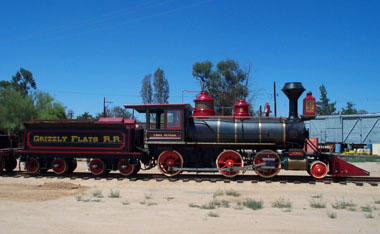 In December 1830 the Charleston and Hamborg locomotive named Best Friend pulled
the first scheduled passenger train of several cars ever moved by steam on tracks in the United States. On opening
day the train reportedly ran at a rate of 21 miles per hour. The locomotive was built by the West Point Foundry in
New York.
In December 1830 the Charleston and Hamborg locomotive named Best Friend pulled
the first scheduled passenger train of several cars ever moved by steam on tracks in the United States. On opening
day the train reportedly ran at a rate of 21 miles per hour. The locomotive was built by the West Point Foundry in
New York.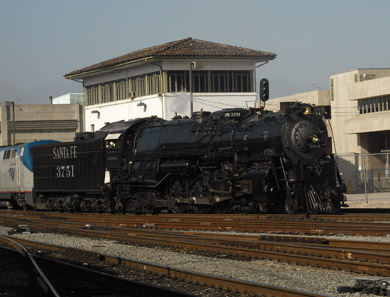
 Ventura County Locomotive No. 2 was originally built as No.
107 for the Cascade Timber Company of Reliance, Washington. The engine was designed to burn
coal, but as a logger she probably burned wood as well. Operations on the Cascade Timber
30-mile line ended in 1942. During World War II the Ventura County Railway acquired
additional locomotives. Renumbered as No. 2, the locomotive
helped move war supplies needed for construction in the Pacific. Built 1922, by the Baldwin
Locomotive Works, Philadelphia, Pa. (#55415), Type: 2-6-2 Prairie, Driver size 44 in, Cylinder
Size: 18 in. x 24 in. Engine Weight: 132,270 lbs., Fuel: oil. Estimated 400 drawbar horsepower,
Estimated top speed 44 miles per hour.
Ventura County Locomotive No. 2 was originally built as No.
107 for the Cascade Timber Company of Reliance, Washington. The engine was designed to burn
coal, but as a logger she probably burned wood as well. Operations on the Cascade Timber
30-mile line ended in 1942. During World War II the Ventura County Railway acquired
additional locomotives. Renumbered as No. 2, the locomotive
helped move war supplies needed for construction in the Pacific. Built 1922, by the Baldwin
Locomotive Works, Philadelphia, Pa. (#55415), Type: 2-6-2 Prairie, Driver size 44 in, Cylinder
Size: 18 in. x 24 in. Engine Weight: 132,270 lbs., Fuel: oil. Estimated 400 drawbar horsepower,
Estimated top speed 44 miles per hour.